

From Frustration to Fluency:
A Framework for Attorney Adoption of Artificial Intelligence

Abstract
The legal profession has witnessed a rapid acceleration in the adoption of artificial intelligence tools. Despite this surge, a significant divide remains between simply adopting AI and achieving effective, reliable integration into legal workflows. This article explores the structural and behavioral origins of attorney frustration with AI tools, grounding these challenges within established theoretical frameworks such as the Delta Model, Susskind’s commoditization spectrum, and the Jagged Frontier research by Dell’Acqua, Mollick, and colleagues.
By referencing peer-reviewed work in computer science, legal ethics, and organizational behavior, the analysis demonstrates that the primary obstacle to successful AI use is procedural—not technological. The path to reliable AI collaboration in legal practice is paved with deliberate workflow design, disciplined prompt engineering, and rigorous verification processes. Attorneys who internalize this approach will not only navigate the transition to AI-augmented practice but also shape its future direction, setting new standards for the profession.
List of Figures
Figure 1. From Frustration to Fluency: At-a-Glance Framework (overview map of the article’s logic).
Figure 2. How LLMs Generate Output (why fluency ≠ accuracy; “no truth register”).
Figure 3. The Ethics Floor: Verification & Supervision Workflow (Model Rules mapped to practical checks).
Figure 4. The Jagged Frontier (tasks where AI helps vs harms; centaur vs cyborg vs self-automator).
Figure 5 & 6. Theoretical Capability vs Observed Exposure (Massenkoff & McCrory, Anthropic; existing source note).
Figure 7. The Delta Model Triangle (Practice / Process / People competency map).
Figure 8. Three-Phase Implementation Roadmap (timeline: 1–6 months; 6–18 months; 18+ months).
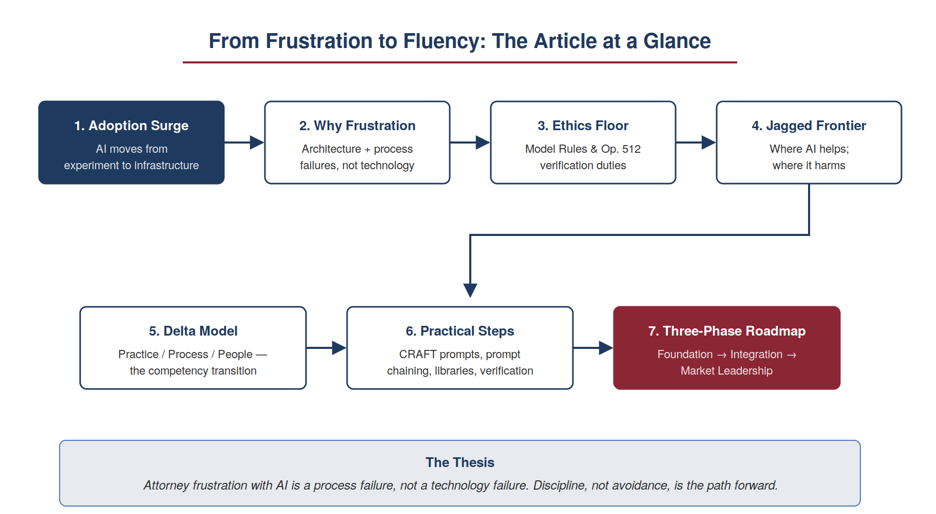
Figure 1. From Frustration to Fluency: At-a-Glance Framework.
I. Introduction
The legal profession has weathered many technological disruptions—from typewriters to Westlaw, from fax machines to e-discovery platforms. Each transition generated anxiety, skepticism, and ultimately adaptation. The current moment is categorically different. For the first time in the profession’s history, artificial intelligence is not merely automating routine clerical work. As Wharton professor Ethan Mollick observed in his landmark study of AI adoption, it threatens to automate the cognitive tasks—research, analysis, synthesis, drafting—that have long constituted the lawyer’s core value proposition,1 while Goldman Sachs economists estimated that forty-four percent of legal tasks are meaningfully exposed to automation, the highest concentration of any profession studied.2 This author suspects that number is closer to seventy percent.
The numbers confirm that a transition is underway. The American Bar Association’s 2024 Legal Technology Survey found that thirty percent of attorneys reported active AI use in their offices, nearly triple the eleven percent reported just one year earlier.3 Additionally, a 2025 Association of Corporate Counsel survey found that sixty-four percent of in-house legal departments expected generative AI to reduce their reliance on outside counsel,4 and by December 2025, the ABA Task Force on Law and Artificial Intelligence declared, without equivocation, that AI had moved from experiment to infrastructure for the legal profession.5
Yet adoption and effective use are not the same thing. The same surveys that document rapid uptake also document widespread frustration: attorneys who spent more time correcting AI output than doing the work themselves; briefs filed with fabricated citations that could not be located by opposing counsel or the court; workflows disrupted rather than improved. The question worth examining is not whether lawyers should use AI—that question is largely settled—but why so many early adopters find the experience unreliable, and what they must do differently.
I believe that attorney frustration with AI is, at its root, a process failure rather than a technology failure. Reliable systems have always been built around imperfect components through process design. Medicine uses peer review; accounting uses double-entry bookkeeping; aviation uses checklists. AI requires the same discipline, applied to its known failure modes. Attorneys who understand those failure modes—and build deliberate workflows around them—will discover that the technology performs far better than its critics believe. Those who do not will continue to experience exactly the frustrations that dominate the early literature.
II. Understanding the Machine: The Foundation of Effective Use
The first source of attorney frustration is architectural ignorance. Most practitioners approach AI as a more sophisticated search engine, asking it questions and expecting reliable answers. This expectation misunderstands what the technology actually does. A large language model does not retrieve information; it generates statistically probable sequences of text based on patterns learned from training data. Computer scientists Ziwei Xu and colleagues have formally demonstrated, using computability theory, that LLMs cannot learn all computable functions and will therefore inevitably generate false output when used as general problem solvers.6 In a complementary mathematical proof published in the Proceedings of the Annual ACM Symposium on Theory of Computing, Adam Kalai and Santosh Vempala established that hallucinations are a statistical inevitability for well-calibrated language models, irrespective of architecture or data quality.7 The problem, in other words, is not a fixable bug. It is structural, and while this will continue to improve over time the nature of the math remains predictive.
These findings reframe the attorney’s relationship to AI output. The technology produces confident text regardless of whether that text is accurate. As Bender and colleagues argued in the “Stochastic Parrots” paper, language models engage in form without meaning—generating text through statistical pattern-matching that has no connection to truth or verification.8 What this article terms the “binary ceiling” reflects that structural reality: at the foundation of every AI response, however fluent and authoritative, is a computational process that knows nothing of accuracy, nothing of uncertainty, and nothing of professional responsibility. There is no truth register in the architecture. There is no uncertainty register either.
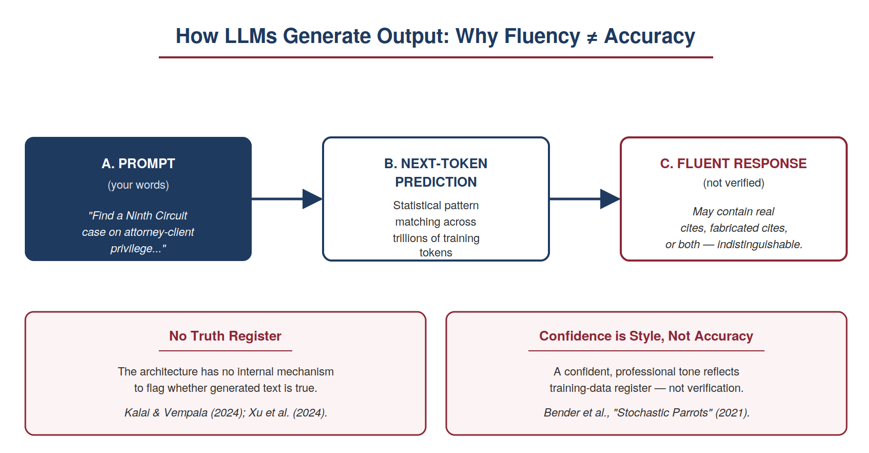
Figure 2. How LLMs Generate Output: Why Fluency ≠ Accuracy.
This architectural reality explains the phenomenon that has generated the most litigation and disciplinary consequences: hallucination. When an AI model generates a case citation that does not exist, it is not malfunctioning. It is functioning precisely as designed, completing the statistically most probable next token given everything that preceded it. In the decision Mata v. Avianca, Inc., attorneys LoDuca and Schwartz submitted a brief containing at least six nonexistent cases, complete with fabricated internal quotations, procedural histories, and docket numbers. When the court could not locate the cited authorities and demanded explanation, the attorneys initially doubled down, submitting supplemental filings that attempted to defend the citations.9 Judge Castel imposed monetary sanctions, observing that attorneys had an independent gatekeeping obligation regardless of the tool used to prepare submissions.
The Mata v. Avianca decision was not an isolated incident. Colorado attorney Crabill was suspended for ninety days after submitting ChatGPT-generated citations to a court and, upon discovering the citations were fabricated, falsely attributed the error to a legal intern rather than disclosing the AI’s role.10 In the two years following Mata, a researcher tracking AI-generated legal errors documented nearly five hundred such incidents across court filings worldwide, three hundred twenty-four of them in United States courts alone.11 These incidents share a common root cause: attorneys who did not understand that the technology has no mechanism for flagging when it is wrong.
Stanford researchers found hallucination rates ranging from seventeen to eighty-eight percent across leading legal AI tools depending on the platform and the specificity of the query.12 The Journal of Legal Analysis study by Dahl and colleagues confirmed that LLMs cannot reliably predict when they are producing legal hallucinations, establishing that the absence of internal error-awareness is not a marginal limitation but a defining characteristic of the technology.13 These figures are not an indictment of AI in law; they are a specification of the current technology and how verification processes must be designed. An attorney who understands that any AI-generated citation must be independently confirmed before filing is not disadvantaged by AI. An attorney who assumes that the fluency of the output is evidence of its accuracy is the one at risk.
III. The Ethics Floor: Professional Obligations in an AI-Augmented Practice
The professional responsibility framework governing AI use is not ambiguous. It was in place before generative AI became widely accessible, and it has been meaningfully elaborated since. ABA Model Rule 1.1, Comment 8, adopted in 2012, requires that attorneys keep abreast of changes in the law and its practice, including the benefits and risks associated with relevant technology.14 This comment has since been adopted or adapted by forty states, the District of Columbia, and Puerto Rico, and establishes that technological competence is not optional or aspirational—it is a floor.
ABA Formal Opinion 512, issued July 29, 2024, is the first ethics opinion to address generative AI specifically. It addresses six areas of Model Rules practice: competence under Rule 1.1; confidentiality under Rule 1.6; communication under Rule 1.4; supervision of nonlawyers under Rules 5.1 and 5.3; candor to the tribunal under Rules 3.1 and 3.3; and the reasonableness of fees under Rule 1.5.15 The Opinion requires that attorneys exercise an “appropriate degree of independent verification or review” of AI-generated output before relying on it, and makes clear that AI tools “lack the ability to understand the meaning of the text they generate or evaluate its context.” The Opinion’s treatment of fees deserves particular attention: attorneys may not bill clients for time spent learning to use AI tools generally, but may bill for time spent inputting client information into AI systems and reviewing AI-generated output.
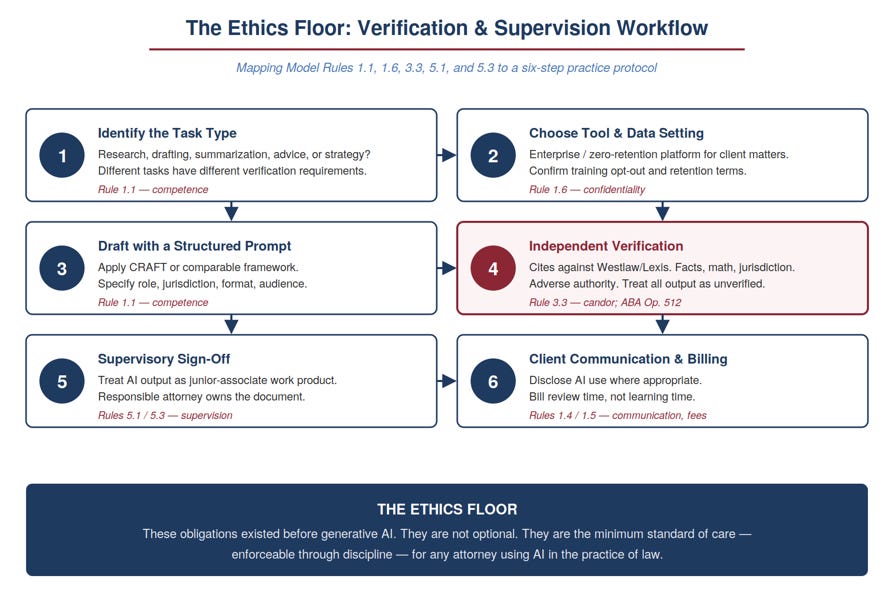
Figure 3. The Ethics Floor: Verification & Supervision Workflow.
Opinion 512’s supervision analysis is equally significant. It treats AI output as analogous to the work product of an inexperienced nonlawyer assistant: the supervising attorney bears full responsibility for ensuring that the output is competent, accurate, and compliant with professional obligations, regardless of whether the attorney reviewed every word. Georgetown law scholars have elaborated that this analogy to Rule 5.3 requires supervision that is “analogous to human assistants”—lawyers must instruct, oversee, and review AI work product with the same care they would apply to a junior associate’s first draft.16 The framing has direct practical implications: an attorney who submits an AI-generated brief without verifying its citations has not merely made a factual error; she has breached her supervisory obligations. The distinction matters because it reframes AI adoption from a convenience question to a liability question.
State bar ethics opinions have reinforced and extended the ABA’s guidance. The State Bar of California’s 2023 practical guidance requires lawyers to “critically review, validate, and correct both the input and the output of generative AI” and states that “overreliance on AI tools is inconsistent with the active practice of law.”17 Oregon’s 2025 Formal Opinion No. 2025-205 cites Stanford research finding that general-purpose LLMs hallucinate at least seventy-five percent of the time when answering questions about a court’s core rulings, making verification the baseline rather than the exception.18 The New York City Bar Association’s Formal Opinion 2024-5 states simply that attorneys “cannot rely on technology without verification.”19 Collectively, these opinions establish that the duty to verify AI-generated output is not a matter of best practices; it is a matter of professional obligation, enforceable through discipline.
Idaho practitioners should also be aware of the Idaho Office of Administrative Hearings’ September 2025 Guidelines, which prohibit administrative law judges from using AI to write or outline orders and decisions, or to conduct legal research in case proceedings, citing an unacceptable risk of hallucinated citations.20 The Idaho Supreme Court’s AI Governance Work Group, launched the same month under Chief Justice Bevan, is engaged in a yearlong process of developing principles for AI use across the state’s court system.21 These developments signal that the rules governing AI use in Idaho proceedings are actively evolving and that attorneys should monitor the Work Group’s output closely.
Lastly, the confidentiality implications of AI use deserve separate attention. Attorneys who input client data into consumer-facing AI platforms—including general-purpose systems whose terms of service permit use of data for model training—may be creating confidentiality exposure under Rule 1.6. A February 2026 federal district court decision held that documents created using a consumer-grade generative AI platform were not protected by attorney-client privilege, in part because the platform’s data retention practices created a third-party disclosure issue.22 Practitioners should use AI platforms specifically designed for legal use with enterprise-grade zero-retention architectures, and should obtain appropriate client consent where AI use involves confidential client information.
IV. The Jagged Frontier: Understanding Where AI Helps and Where It Harms
Understanding the limits of AI competence is as important as understanding its power. The most rigorous empirical study of AI performance in professional settings—a 2023 field experiment by Dell’Acqua, Mollick, and colleagues at Harvard Business School and Boston Consulting Group, involving 758 consultants using GPT-4—identified what the researchers termed the Jagged Frontier.23 Inside the frontier, defined as tasks within the model’s training distribution, AI users completed tasks 25.1% faster, produced results rated 40% higher in quality, and completed 12.2% more tasks overall. Outside the frontier, the results inverted: AI users performed nineteen percentage points worse than those working without AI, as the model pattern-matched its way to confident but wrong conclusions.
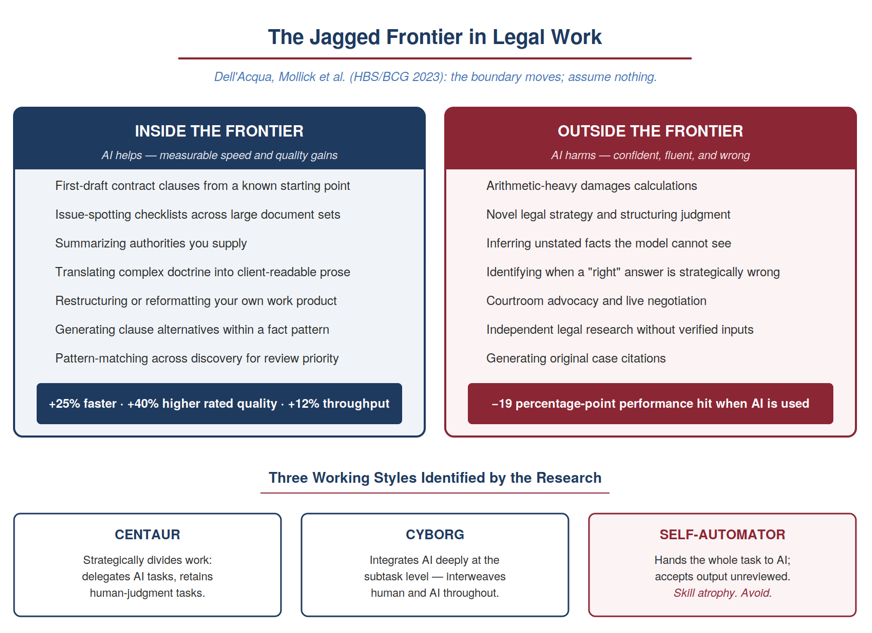
Figure 4. The Jagged Frontier in Legal Work.
In the legal context, the Jagged Frontier maps to recognizable distinctions. AI excels at synthesizing large bodies of case law for pattern identification, generating clause alternatives from a given starting position, identifying risk categories across large document sets, and producing first-draft content in well-structured legal formats. While changing almost daily it struggles with basic arithmetic in damages calculations, with maintaining logical consistency across long documents, and—most dangerously for practitioners—without knowing when a technically correct answer is strategically wrong. The model cannot assess whether a legal position, however accurately stated, serves the client’s interests given facts it cannot perceive.
Empirical data from Anthropic’s own usage research provides granular confirmation of the Jagged Frontier thesis. A March 2026 study by Massenkoff and McCrory, drawing on the Anthropic Economic Index and task-level data for approximately 800 occupations, introduced the concept of “observed exposure” — a measure that weights not merely theoretical LLM capability but actual automated, work-related usage patterns on the platform.24 The study’s central finding is instructive: AI is far from reaching its theoretical capability, and actual coverage remains a fraction of what is feasible. For example, while theoretical capability assessments show that LLMs could potentially speed up ninety-four percent of tasks in Computer and Math occupations and ninety percent in Office and Administrative occupations, observed exposure — what AI is actually doing in professional settings — covers only thirty-three percent of Computer and Math tasks. The gap between the blue area (theoretical capability) and the red area (actual observed usage) in Figures 5 and 6 illustrate precisely the dynamic the Jagged Frontier research identified in experimental settings: broad theoretical potential does not translate automatically or uniformly into realized deployment. Notably, the study confirms that tasks remaining beyond AI’s current reach include not only physical labor like agricultural work, but also legal tasks such as representing clients in court — reinforcing that the locus of irreplaceable attorney value lies in the contextual, relational, and advocacy dimensions of practice that no training corpus can replicate.
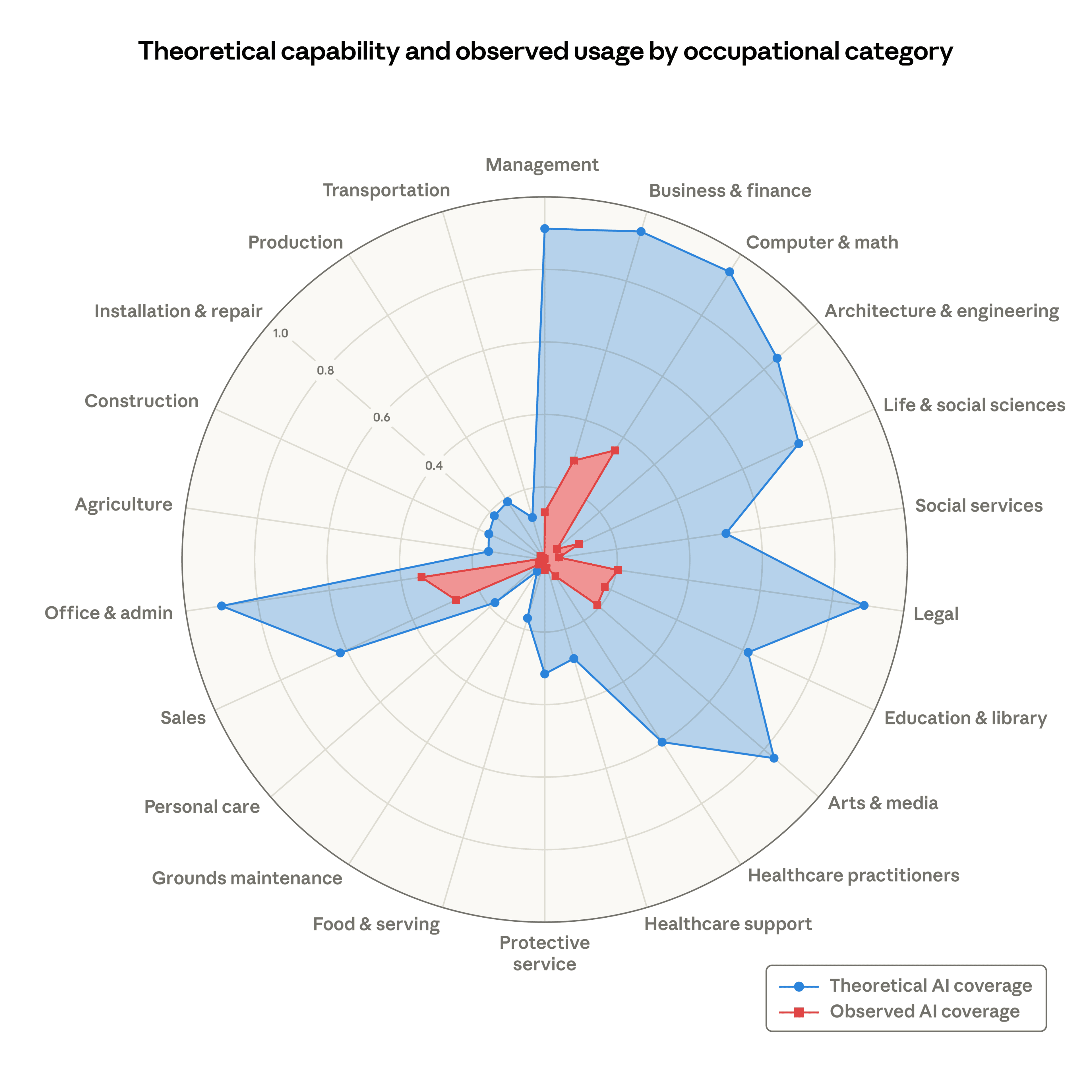
Figure 5. Theoretical Capability and Observed Usage by Occupational Category (Radar View). Source: Maxim Massenkoff & Peter McCrory, Labor Market Impacts of AI: A New Measure and Early Evidence, Anthropic (Mar. 5, 2026). Each axis represents an occupational category; the blue trace shows the share of tasks LLMs could theoretically perform, and the red trace shows actual coverage derived from Anthropic Economic Index usage data. The radar makes the cross-occupation pattern visible: high theoretical capability across most knowledge-work categories, with observed usage collapsing toward the center almost everywhere — including Legal.
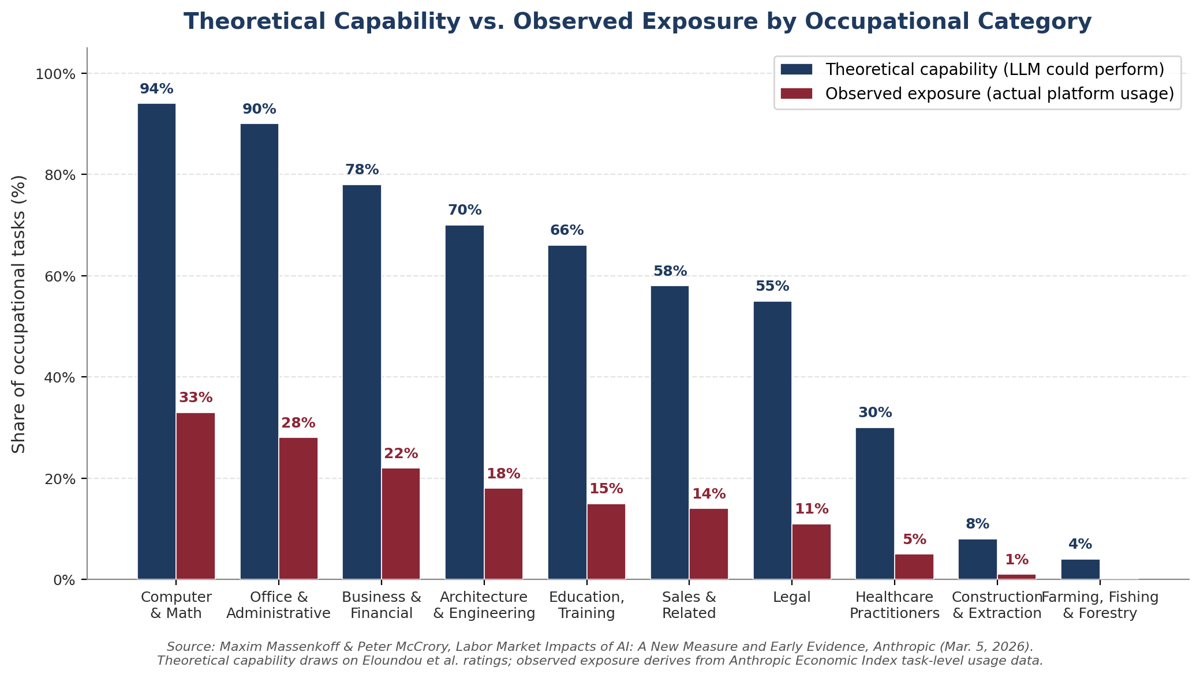
Figure 6. Theoretical Capability and Observed Exposure by Occupational Category. Source: Maxim Massenkoff & Peter McCrory, Labor Market Impacts of AI: A New Measure and Early Evidence, Anthropic (Mar. 5, 2026). The blue area shows the share of job tasks that LLMs could theoretically perform; the red area shows actual job coverage derived from Anthropic Economic Index usage data. The gap between the two areas represents the portion of theoretically feasible tasks not yet seeing real-world AI deployment.
The Jagged Frontier research also produced a finding with direct implications for how practitioners should structure their relationship with AI tools. The study identified two productive working styles: the Centaur, who strategically divides work between human and AI by delegating tasks where AI excels and personally retaining tasks where it does not; and the Cyborg, who integrates AI deeply into the work process at the subtask level, interweaving effort continuously throughout the workflow. A subsequent 2025 HBS study refined this taxonomy, identifying a third mode—the Self-Automator—who consolidated the entire workflow into one or two prompts and accepted output with minimal engagement.25 Self-Automators produced work that was fast and polished but lacking in depth, and experienced measurable skill atrophy over time. Anthropic observed that exposure research corroborates this warning from a labor economics perspective: the most exposed occupations are not those with the most routine work, but those-like computer programmers, financial analysts, attorneys, and customer service representatives-where AI augments highly skilled, educated workers. Workers in the top quartile of AI exposure earn forty-seven percent more, on average, than those with zero exposure, and are nearly four times as likely to hold graduate degrees. The professional stakes of defaulting to Self-Automator behavior are therefore highest precisely for the knowledge workers, including attorneys, who stand to gain the most from deliberate Centaur or Cyborg approaches. The practical message for attorneys is clear: AI should amplify professional judgment, not replace the exercise of it.
Richard Susskind, whose work has done more than any other to theorize the structural transformation of legal services, warns against what he calls “Technological Myopia”—the tendency to see AI as simply “swapping machines and lawyers” rather than as an opportunity to deliver client outcomes in fundamentally different ways.26 This distinction shapes the lawyer’s proper relationship to AI. The attorney who treats AI as a labor-saving device for current work will realize modest gains. The attorney who redesigns her workflows around AI’s capabilities—treating herself as the architect of an AI-augmented system rather than merely a user of an AI tool—will realize transformative ones. The ABA’s Young Lawyers Division has made the same point in published guidance: AI is “only as effective and safe as the attorney using it,” and its responsible deployment requires beginning with a “clear, strategic assessment of where [AI] fits into the practice.”27
V. The Delta Model: A Competency Framework for the Transition
Understanding what AI-augmented legal practice demands across the full range of professional competencies requires a framework equal to the complexity of the transition. The Delta Model, originally developed through a 2018 design sprint at Michigan State University’s Legal RnD program by Alyson Carrel, Natalie Runyon, and Caitlin Moon, and subsequently elaborated through the Institute for the Advancement of the American Legal System’s Foundations for Practice project, provides that framework.28 The model visualizes the modern lawyer’s competency as an equilateral triangle, whose three sides represent Practice—traditional legal knowledge, analysis, research, and drafting—Process—technology fluency, project management, data analysis, and business acumen—and People—emotional intelligence, client-centricity, communication, and collaborative skill. The model’s name is deliberate: the Greek delta symbol represents change, and the framework explicitly frames legal competency not as a static credential but as a dynamic, evolving profile.
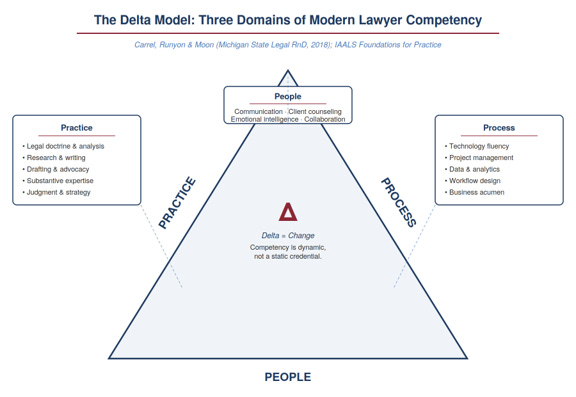
Figure 7. The Delta Model Triangle: Practice / Process / People.
What the Delta model captures that older competency frameworks do not is the interdependence of these three domains in an AI-augmented practice. An attorney who possesses only deep doctrinal expertise—the traditional I-shaped lawyer—is exposed to the commoditization pressure that AI accelerates along Richard Susskind’s spectrum from Bespoke to Standardized to Systematized to Packaged to Commoditized legal work.29 As Susskind has observed, the bespoke layer—creative strategy, novel legal structuring, genuine advocacy—remains the locus of irreplaceable human value precisely because no training corpus can fully represent the contextual judgment and relational intelligence that genuinely novel matters require. Everything below the bespoke layer is subject to progressive systemization, and AI is currently accelerating that migration by compressing timelines for commoditization that once took decades.
Economist David Autor has framed the same dynamic from the supply side: AI is best understood not as a replacement for expertise but as an amplifier of it, capable of extending the reach and relevance of expert judgment to a broader range of problems and clients.30 What matters, on Autor’s account, is whether attorneys treat AI as a tool for automation—eliminating human effort—or as a tool for collaboration—amplifying human judgment. The attorneys who define the profession’s next chapter will be those who use AI to do more of the work that genuinely requires them, by delegating to AI the work that does not.
Chicago law professor Jack Balkin has offered a complementary framing from the liability perspective. AI programs, Balkin argues, are “like agents that lack intentions but that create risks of harm,” and “people should not be able to obtain a reduced duty of care by substituting an AI agent for a human agent.”31 For practicing attorneys, this means that the supervisory responsibility under Model Rule 5.3 travels with the work product regardless of how it was generated. The lawyer who treats AI as an autonomous agent abdicates not merely efficiency but professional accountability. The lawyer who treats AI as a supervised tool—one component of a deliberate workflow—preserves both.
VI. Practical Steps: From Frustration to Fluency
Understanding the theoretical framework is necessary but insufficient. The most common source of AI frustration in legal practice is not a failure to understand transformer architecture; it is a failure to structure the request appropriately. The emerging consensus in the legal technology literature is that structured prompt engineering—specifying context, role, task, format, and audience in a disciplined way—is what separates reliable AI output from unreliable output. The ABA’s Senior Lawyers Division has noted that the skill of asking well-constructed questions of AI systems is analogous to the Socratic method: the quality of the answer depends fundamentally on the quality of the question.32
The CRAFT framework, formally validated in peer-reviewed research published in the International Journal of Innovative Research and Scientific Studies, provides a structured approach to prompt engineering that has demonstrated performance improvements of 18.4 to 46.8 percent compared to unstructured prompting.33 CRAFT prompts specify five elements: Context, providing the factual and transactional setting; Role, assigning a professional identity to the AI appropriate to the task; Action, defining the specific task to be performed; Format, specifying the desired structure of the output; and Target Audience, identifying the intended reader and appropriate register. A prompt that asks an AI to review this contract and tell me if there are any problems will produce a generic, jurisdiction-free analysis that requires substantial rework. A CRAFT prompt that specifies the attorney’s role, the applicable jurisdiction, the specific provisions to be analyzed, the format of the output—risk table, severity ratings, proposed clause language—and the audience to whom the analysis will be presented will produce analysis that is immediately usable.
Beyond individual prompt quality, the most impactful structural change an attorney can make is to adopt prompt chaining—breaking complex tasks into sequential steps, each building on the output of the last. The technique was introduced in the foundational chain-of-thought prompting research by Wei and colleagues, which demonstrated that sequential intermediate reasoning steps significantly improve multi-step accuracy.34 Legal scholars have since adapted this approach directly to legal tasks: the Legal Syllogism Prompting framework decomposes legal analysis into major premise (the applicable rule), minor premise (the relevant facts), and conclusion—outperforming standard chain-of-thought prompting on legal judgment tasks in controlled studies.35 Applied to due diligence practice, a chained workflow might proceed through four sequential prompts: first, identifying specific provision categories and deviations from standard form; second, prioritizing the highest-risk items and proposing deal-structuring alternatives; third, drafting representations and warranties language addressing the identified risks; and fourth, auditing the drafted language against the original provisions to surface inconsistencies.36 Each step reduces the complexity the model must handle at once, structurally addressing the attention limitations that cause errors in single-prompt approaches to complex tasks.
Attorneys should also maintain prompt libraries: institutional repositories of tested, versioned prompts organized by practice area and task type. Writing in the ABA’s Law Practice Magazine, Pinnington and Trautz draw an explicit analogy between the prompt library and the traditional precedent bank: “For decades, lawyers have gone to their closed files to pull out a document to be used as a precedent . . . With the dawn of networked computers, many firms created digital form libraries.” A well-curated prompt library, they argue, is a “smarter, more flexible version of a form book.”37 The analogy is apt and the functional case is strong. A prompt library preserves institutional knowledge about what works rather than siloing it in individual practice. It establishes a baseline for quality control and auditing. And it accelerates onboarding for attorneys newer to AI-augmented work, eliminating the trial-and-error period that generates the most frustration. The International Legal Technology Association’s generative AI best practice guide similarly recommends formalized prompt management protocols as an essential component of demonstrating quality and defensibility.38
The current landscape of legal AI tools offers practitioners options across every practice domain. Harvey AI, now valued at eight billion dollars with over one thousand clients across sixty countries, offers firm-specific customization through retrieval-augmented generation architectures that ground AI responses in the firm’s own documents and precedents.39 CoCounsel, Thomson Reuters’ agentic AI platform launched in August 2025, integrates deep research capabilities grounded in Westlaw’s database with workflow automation for drafting and document analysis.40 LexisNexis’s Protégé platform provides access to multiple foundation models alongside its own legal knowledge graph of over two hundred billion interconnected documents.41 LegalOn and Spellbook specialize in contract review and drafting, with LegalOn reporting review time reductions of up to eighty-five percent and Spellbook serving nearly four thousand firms in eighty countries.42 Luminance, using a proprietary transformer trained on more than one hundred fifty million verified legal documents, focuses on contract lifecycle management and due diligence workflows.43 These tools are not interchangeable; attorneys should evaluate them against their specific practice needs and the confidentiality and data governance requirements their clients demand.
Verification discipline is the final and non-negotiable element of effective AI practice. ABA Formal Opinion 512 requires an “appropriate degree of independent verification or review” of all AI-generated output before reliance—a standard that, applied to case citations, means confirmation against primary sources before any document that relies on them is filed or delivered to a client.44 This is not merely a best practice; the Oregon Bar has confirmed that failure to verify can constitute a violation of the duties of competence, candor, and supervision simultaneously.45 Attorneys should develop standard documentation practices—recording which tool was used, which model version, what prompt was applied, and what verification steps were taken—both as a matter of professional discipline and as a demonstration of compliance with Opinion 512’s supervisory obligations. The principle at stake is simple: AI does not sign the brief. The lawyer does.
VII. A Three-Phase Implementation Roadmap
Effective AI adoption does not require a firm-wide transformation initiative. The attorneys who lead their profession through this transition will be those who start with a single workflow, build process discipline around it, and compound their advantage over time. Research consistently shows that phased implementation outperforms enterprise-wide simultaneous deployment: organizations using staged rollouts experience thirty-five percent fewer critical implementation issues, and those with a visible, defined AI strategy are 3.5 times more likely to experience material AI benefits than those with ad-hoc approaches.46 The three-phase structure proposed here draws on this literature to provide a practical roadmap that requires no budget and no organizational permission to begin.47
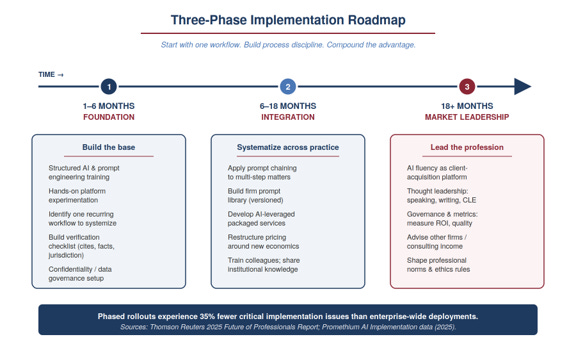
Figure 8. Three-Phase Implementation Roadmap (1–6 months; 6–18 months; 18+ months).
In the first phase, spanning the first one to six months of serious AI engagement, the attorney’s objective is foundation building. This means completing structured training in legal AI and prompt engineering—including the ABA’s own developing resources, bar association CLE programming, and published prompt engineering guides adapted for legal practice—and then engaging in disciplined hands-on experimentation with major platforms. It means mapping current workflows for AI opportunities by identifying which recurring tasks involve the most pattern-matching and least contextual judgment: initial document review, first-pass research memos, standard correspondence templates. And it means creating basic quality control checklists—the verification protocols and output review criteria that form the backbone of reliable AI use.
In the second phase, spanning months six through eighteen, the attorney’s objective is advanced integration. This means developing expertise in the AI tools most relevant to the practice areas, implementing prompt chaining and structured prompts systematically across recurring task types, building or contributing to a prompt library, and creating packaged legal service offerings that leverage AI efficiency to deliver value at price points that were previously economically impossible. An attorney whose AI-assisted contract review takes forty-five minutes instead of three hours can price that service differently without reducing margin—a competitive advantage that compounds with each workflow systematized. Harvard Law School’s Center on the Legal Profession has documented firms reporting productivity gains “greater than 100 times” on specific task types following systematic AI integration.48
In the third phase, spanning eighteen months and beyond, the attorney’s objective is market leadership: using demonstrated AI fluency as a platform for client acquisition, developing thought leadership in the profession on AI-augmented practice, and, where appropriate, building consulting capabilities for other practitioners navigating the same transition. Axiom Law’s AI maturity research identifies a persistent gap between access and maturity—finding that sixty-six percent of legal departments are at a “developing” stage despite having AI tools available—confirming that the competitive advantage belongs not to those who have the tools but to those who have developed the institutional discipline to use them well.49
VIII. Conclusion
The legal profession’s relationship with artificial intelligence is not a question that will be resolved by waiting. The competitive dynamics are already operative: in-house teams are using AI to reduce the volume of work they send to outside counsel; alternative legal service providers are using AI to deliver commoditized legal work at fractions of traditional rates; and the attorneys who have built disciplined AI workflows are demonstrating productivity and quality advantages that their peers without those workflows cannot match.
What this article has attempted to establish is that the frustrations that have defined the early AI adoption experience in law are not an indictment of AI as a technology. They are a predictable consequence of deploying a powerful but structurally imperfect tool without the process discipline that responsible use requires. Computer scientists have proven mathematically that hallucinations are a structural inevitability.50 The technology does not know when it is wrong. The attorney must. The technology produces confident output regardless of reliability. The attorney must verify. The technology optimizes for pattern completion. The attorney must exercise the contextual judgment and relational intelligence that no training corpus can replicate.
Ethan Mollick’s most practically useful counsel to professionals navigating this transition is to assume that the current AI tools are the worst AI they will ever use—that capabilities will expand, frontier limitations will recede, and the workflows built today will compound in value as the technology improves.51 The attorneys who build those workflows now, who invest in prompt libraries and verification protocols and disciplined adoption roadmaps, are not merely keeping pace with a technological transition. They are designing the future of a profession that will continue to require, above all else, the irreplaceable exercise of human judgment. That judgment—strategic, ethical, relational, and contextual—is and will remain the delta that no model can close.
About the Author:
David M. Fogg is the founder and principal attorney of Cornerstone Tech and Estate Advisors, PLLC, a forward-thinking law firm licensed in Idaho, Washington, and Arizona. David has built a distinguished four-decade career in engineering, technology, and law — the first two-decades beginning with aerospace work on the F-16 aircraft at General Dynamics and networking standards development at Johns Hopkins Applied Physics Laboratory, through senior roles at IBM where he served as Hot Process Best of Breed Equipment Manager and as an IBM assignee to the SEMATECH consortium in Austin, Texas, contributing to the industry-defining Standardized Supplier Quality Assessment (SSQA) program. His technical career culminated as Director of Engineering and Manufacturing for IBM's Semiconductor BAT facility in Singapore, followed by his tenure as CEO of Nano Silicon Technologies, Ltd.
After earning his Juris Doctorate from the University of Idaho in 2007, David brought that depth of technical and executive experience to the practice of law. He currently chairs the Technology and Management Bar Section of the Idaho State Bar, with a significant focus on machine learning, artificial intelligence, and large language models, and serves on the Technology Working Group of the Arizona State Bar. At Cornerstone, his practice centers on business law, estate planning, real estate, and technology matters, with a commitment to reimagining legal services through the same spirit of innovation that defined his engineering career.
As a strong believer in lifelong learning, David’s academic pursuits have continued throughout his career. He earned a B.S. in Design Engineering and Technology from Brigham Young University in 1985 and began an M.S. program in Computer Science at Johns Hopkins University in 1989, but ultimately returned to full-time academia to complete an M.S. in Manufacturing Engineering at Brigham Young University in 1990, graduating summa cum laude and being selected for membership in the nation’s oldest honor society, Phi Kappa Phi. His academic emphasis was on robotics and advanced composites, with a thesis exploring glass–polycarbonate matrix adhesion techniques. David returned to academia to earn his Juris Doctor in 2007 and is currently enrolled in the University of Colorado Boulder’s M.S. program in Artificial Intelligence.
David M. Fogg can be reached at admin@cornerstonetea.com.
Endnotes
Ethan Mollick, Co-Intelligence: Living and Working with AI (Portfolio/Penguin 2024). Mollick served as faculty associate at the Wharton School, University of Pennsylvania. https://www.penguinrandomhouse.com/books/741805/co-intelligence-by-ethan-mollick/
Joseph Briggs & Devesh Kodnani, The Potentially Large Effects of Artificial Intelligence on Economic Growth, Goldman Sachs Global Economics Analyst (Mar. 26, 2023). The 44% figure reflects task exposure to AI automation, not job replacement. https://www.gspublishing.com/content/research/en/reports/2023/03/27/d64e052b-0f6e-45d7-967b-d7be35fabd16.html
Mark J. Calaguas, 2024 Artificial Intelligence TechReport, ABA Legal Technology Resource Center (Mar. 2025), https://www.americanbar.org/groups/law_practice/resources/tech-report/2024/2024-artificial-intelligence-techreport/. The 30.2% figure reflects office-level adoption among private practitioners surveyed.
Ass’n of Corp. Counsel & Everlaw, Generative AI’s Growing Strategic Value for Corporate Law Departments — Survey Results (3d ann. rep., Oct. 14, 2025), https://www.acc.com/about/newsroom/news/acc-genai-report-corporate-law-departments-ai-use-everlaw. The 64% figure reflects forward-looking expectation of reduced outside counsel reliance; 52% of respondents reported currently using GenAI.
ABA AI Task Force report examines opportunities, challenges for legal profession, Addressing the Legal Challenges of AI: Year 2 Report on the Impact of AI on the Practice of Law (Dec. 15, 2025), https://www.americanbar.org/news/abanews/aba-news-archives/2025/12/aba-ai-task-force-report-examines-opportunities-challenges/.
Ziwei Xu et al., Hallucination Is Inevitable: An Innate Limitation of Large Language Models, arXiv:2401.11817 (2024), https://arxiv.org/abs/2401.11817. The authors employ formal computability theory to demonstrate that LLMs “cannot learn all computable functions and will therefore inevitably hallucinate if used as general problem solvers.”
Adam Tauman Kalai & Santosh S. Vempala, Calibrated Language Models Must Hallucinate, 56 Proc. Ann. ACM Symp. on Theory of Computing 160 (2024), https://doi.org/10.1145/3618260.3649777. The paper provides a mathematical proof that hallucinations are a statistical inevitability for well-calibrated language models, irrespective of architecture or data quality.
Emily M. Bender et al., On the Dangers of Stochastic Parrots: Can Language Models Be Too Big?, Proc. 2021 ACM Conf. on Fairness, Accountability & Transparency 610 (2021), https://doi.org/10.1145/3442188.3445922. With over 6,000 citations, this is the foundational paper establishing that LLMs engage in statistical pattern-matching without any reference to meaning or truth.
Mata v. Avianca, Inc., 678 F. Supp. 3d 443 (S.D.N.Y. 2023). The sanctioned attorneys were Peter LoDuca and Steven A. Schwartz of Levidow, Levidow & Oberman, P.C. The $5,000 sanction was imposed jointly and severally. https://www.law.berkeley.edu/wp-content/uploads/archive/2025/12/Mata-v-Avianca-Inc.pdf
In re Zachariah C. Crabill, Stipulation to Discipline, Case No. 23PDJ067, Colo. Sup. Ct. Office of the Presiding Disciplinary Judge (Nov. 22, 2023). https://www.cobar.org/Portals/COBAR/Repository/Family%20Law%20Section%20Folder/AI%20EXHIBITS%20-%20Combined.pdf?ver=QneItjJ2RHdxolLRt08ajg%3D%3D
Damien Charlotin (HEC Paris), AI Hallucination Cases Database (tracking AI-generated errors in court filings worldwide), as reported in Cronkite News, As More Lawyers Fall for AI Hallucinations, ChatGPT Says: Check My Work (Oct. 28, 2025), https://cronkitenews.azpbs.org/2025/10/28/lawyers-ai-hallucinations-chatgpt/.
Varun Magesh et al., Hallucination-Free? Assessing the Reliability of Leading AI Legal Research Tools, J. Empirical Legal Stud. (2025), https://doi.org/10.1111/jels.12413. The study found that even RAG-based specialized legal AI tools hallucinate in more than 17% of queries, with general-purpose models reaching 88%.
Matthew Dahl et al., Large Legal Fictions: Profiling Legal Hallucinations in Large Language Models, 16 J. Legal Analysis 64 (2024), https://doi.org/10.1093/jla/laae003. The study found hallucination rates of 58% (GPT-4) to 88% (Llama 2) and confirmed that LLMs “cannot always predict, or do not always know, when they are producing legal hallucinations.”
ABA Rule 1.1 Competence - Comment (2012), https://www.americanbar.org/groups/professional_responsibility/publications/model_rules_of_professional_conduct/rule_1_1_competence/comment_on_rule_1_1/. The technology competence comment was adopted by the ABA House of Delegates in August 2012.
ABA Standing Comm. on Ethics & Prof’l Responsibility, Formal Op. 512, Generative Artificial Intelligence Tools (July 29, 2024). See also Wendy J. Muchman, Generative Artificial Intelligence Tools: ABA Formal Opinion 512 Provides Needed Guidance, 93 Bar Examiner 20, Fall 2024. https://www.lawnext.com/wp-content/uploads/2024/07/aba-formal-opinion-512.pdf
Lawyer and Judicial Competency in the Era of A.I., Geo. J. Legal Ethics (2022), https://www.law.georgetown.edu/legal-ethics-journal/wp-content/uploads/sites/24/2022/08/GT-GJLE210005.pdf (addressing supervision of AI under Rule 5.3 and the analogy to human nonlawyer assistants).
State Bar of Cal. Standing Comm. on Prof’l Responsibility & Conduct, Practical Guidance for the Use of Generative Artificial Intelligence in the Practice of Law (Nov. 16, 2023), https://www.calbar.ca.gov/Portals/0/documents/ethics/Generative-AI-Practical-Guidance.pdf.
Or. State Bar, Formal Op. No. 2025-205: Artificial Intelligence Tools (Feb. 2025), https://www.osbar.org/_docs/ethics/2025-205.pdf (citing Stanford research and addressing competence, candor, and supervision obligations).
N.Y.C. Bar Ass’n Prof’l Ethics Comm., Formal Op. 2024-5: Generative AI in the Practice of Law (2024), https://www.nycbar.org/reports/formal-opinion-2024-5-generative-ai-in-the-practice-of-law/.
Idaho Office of Admin. Hearings, Guidelines for Administrative Law Judges Regarding the Use of Artificial Intelligence (Sept. 24, 2025), https://oah.idaho.gov/wp-content/uploads/2025/09/OAH-AI-Guidelines.pdf.
Chief Justice G. Richard Bevan, AI in the Courts: Balancing Tradition and Innovation, Idaho State Bar (Dec. 29, 2025), https://isb.idaho.gov/blog/ai-in-the-courts-balancing-tradition-and-innovation-by-chief-justice-g-richard-bevan/.
United States v. Heppner, No. 25-cr-00503-JSR ECF 27 (S.D.N.Y. Feb. 17, 2026), discussed in K&L Gates LLP, Litigation Minute: Generative AI Data, Attorney-Client Privilege, and the Work-Product Doctrine (Feb. 23, 2026), https://www.klgates.com/Litigation-Minute-Generative-AI-Data-Attorney-Client-Privilege-and-the-Work-Product-Doctrine-2-23-2026.
Fabrizio Dell’Acqua et al., Navigating the Jagged Technological Frontier: Field Experimental Evidence of the Effects of AI on Knowledge Worker Productivity and Quality, Harv. Bus. Sch. Working Paper No. 24-013 (Sept. 15, 2023), https://papers.ssrn.com/sol3/papers.cfm?abstract_id=4573321. Published in 53 Rsch. Pol’y __ (2024).
Maxim Massenkoff & Peter McCrory, Labor Market Impacts of AI: A New Measure and Early Evidence, Anthropic (Mar. 5, 2026), https://www.anthropic.com/research/labor-market-impacts. The study introduces an “observed exposure” measure combining O*NET task data, Eloundou et al. theoretical capability ratings, and Anthropic Economic Index usage data. Key findings: computer programmers (75% coverage), customer service representatives, and financial analysts are among the most exposed occupations; workers in the top quartile of exposure earn 47% more and are nearly four times as likely to hold graduate degrees as those with zero exposure; and no systematic increase in unemployment for highly exposed workers has been detected to date, though hiring of workers aged 22–25 into exposed occupations has slowed by approximately 14%.
Steven Randazzo et al., Cyborgs, Centaurs and Self-Automators: The Three Modes of Human-GenAI Knowledge Work and Their Implications for Skilling and the Future of Expertise, Harv. Bus. Sch. Working Paper No. 26-036 (Dec. 8, 2025), https://ssrn.com/abstract=4921696.
Richard Susskind, How to Think About AI: A Guide for the Perplexed (Oxford Univ. Press 2025), https://academic.oup.com/book/59718. See also Richard Susskind, Tomorrow’s Lawyers: An Introduction to Your Future (3d ed. Oxford Univ. Press 2023), https://academic.oup.com/oxford-law-pro/book/60058 (arguing lawyers must be “involved in building the systems that will replace outmoded forms of legal work”).
Am. Bar Ass’n Young Lawyers Div., A Guide for Responsibly Implementing AI in Legal Practice (2024), https://www.americanbar.org/groups/young_lawyers/resources/tyl/practice-management/guide-implementing-ai-tools-legal-practice/.
Natalie Runyon & Alyson Carrel, Adapting for 21st Century Success: The Delta Lawyer Competency Model, Legal Executive Institute White Paper (2019), https://legal.thomsonreuters.com/en/forms/delta-model?gatedContent=%252Fcontent%252Fewp-marketing-websites%252Flegal%252Fgl%252Fen%252Finsights%252Fwhite-papers%252Fdelta-model. Inst. for the Advancement of the Am. Legal Sys. (IAALS), Foundations for Practice: The Whole Lawyer and the Character Quotient (2016), https://iaals.du.edu/publications/foundations-practice-whole-lawyer-and-character-quotient.
Richard Susskind, The End of Lawyers? Rethinking the Nature of Legal Services 29, 37 (OUP 2008); Richard Susskind, Tomorrow’s Lawyers, supra note 26. Susskind’s five-stage commoditization spectrum—Bespoke, Standardized, Systematized, Packaged, Commoditized—provides the foundational framework for understanding AI’s structural impact on legal service delivery. https://academic.oup.com/hrlr/article-abstract/10/4/797/782659
David H. Autor, Applying AI to Rebuild Middle Class Jobs, NBER Working Paper No. 32140 (Feb. 2024), https://www.nber.org/papers/w32140. Autor’s thesis is explicitly framed as an argument about the potential of AI to extend rather than replace expertise.
Jack M. Balkin, The Law of AI Is the Law of Risky Agents Without Intentions, U. Chi. L. Rev. Online (2024), https://lawreview.uchicago.edu/online-archive/law-ai-law-risky-agents-without-intentions.
Jeffrey Allen, Prompt Engineering: The New Art of Asking Questions, ABA Voice of Experience (Oct. 2025), https://www.americanbar.org/groups/senior_lawyers/resources/voice-of-experience/2025-october/prompt-engineering/.
Allen Paul Esteban, Creative CRAFT: A Structured Framework for Creativity-Driven Prompt Engineering in Generative AI, 8 Int’l J. Innovative Rsch. & Sci. Stud. (IJIRSS) 1651 (2025), DOI: 10.53894/ijirss.v8i5.9229, https://ijirss.com/index.php/ijirss/article/view/9229.
Jason Wei et al., Chain-of-Thought Prompting Elicits Reasoning in Large Language Models, 35 Advances in Neural Info. Processing Sys. 24824 (2022),
Cong Jiang & Xiaolei Yang, Legal Syllogism Prompting: Teaching Large Language Models for Legal Judgment Prediction, Proc. 19th Int’l Conf. on A.I. & L. 417 (2023), https://doi.org/10.1145/3594536.3595170. See also Joel Niklaus et al., Large Language Model Prompt Chaining for Long Legal Document Classification, arXiv:2308.04138 (2023), https://arxiv.org/abs/2308.04138 (demonstrating prompt chaining outperforms zero-shot methods for legal document classification).
For M&A due diligence workflow frameworks employing comparable multi-step AI approaches, see Nina L. Flax, 7 Practical Ways to Use AI in M&A Transactions, Mayer Brown Client Alert (Sept. 3, 2025), https://www.mayerbrown.com/en/insights/publications/2025/09/7-practical-ways-to-use-ai-in-manda-transactions; Norton Rose Fulbright, Integrating Artificial Intelligence in M&A Processes: A New Strategic Era — Part 1 (2025), https://www.nortonrosefulbright.com/en/knowledge/publications/5f5749a7/.
Dan Pinnington & Reid F. Trautz, Developing AI Prompt Libraries for Smarter Drafting, ABA L. Prac. Mag., Sept./Oct. 2025, https://www.americanbar.org/groups/law_practice/resources/law-practice-magazine/2025/september-october-2025/developing-ai-prompt-libraries-for-drafting/.
ILTA Generative AI Best Practice Guide (Outgoing Disclosure), Int’l Legal Tech. Ass’n (May 6, 2025), https://www.fieldfisher.com/en/insights/ilta-generative-ai-best-practice-guide-outgoing-disclosure (recommending “prompt management protocols to ensure quality and defensibility”).
Harvey AI valuation and customer data: TechCrunch, Legal AI Startup Harvey Confirms $8B Valuation (Dec. 4, 2025), https://techcrunch.com/2025/12/04/legal-ai-startup-harvey-confirms-8b-valuation/.
Thomson Reuters, CoCounsel Legal Launch, PR Newswire (Aug. 2025), https://www.prnewswire.com/news-releases/thomson-reuters-launches-cocounsel-legal-transforming-legal-work-with-agentic-ai-and-deep-research-302521761.html.
LexisNexis, Lexis+ with Protégé Launch (Feb. 2026), https://www.lawnext.com/2026/02/lexisnexis-launches-lexis-with-protege-replacing-lexis-ai-with-an-end-to-end-workflow-platform.html.
LegalOn Technologies, LegalOn Breaks Record as Fastest AI Company Founded in Japan to Reach ¥10 Billion ARR. Milestone underscores LegalOn’s evolution from contract review pioneer to global leader in legal AI for business Press Release (Oct. 2025), https://en.legalontech.jp/3274/; Business Wire, Spellbook Raises $50M Series B (Oct. 9, 2025), https://www.businesswire.com/news/home/20251009110230/en/Spellbook-Raises-$50M-Series-B-to-Expand-AI-Contract-Review-Platform.
TechCrunch, Legal Tech Startup Luminance Raises $75M (Feb. 18, 2025), https://techcrunch.com/2025/02/18/legal-ai-startup-luminance-backed-by-the-late-mike-lynch-raises-75m/.
ABA Standing Comm. on Ethics & Prof’l Responsibility, Formal Op. 512, supra note 15. See also Holland & Knight, Generative AI and the Duty of Competence Conundrum (Feb. 2025), https://www.hklaw.com/en/insights/publications/2025/02/generative-ai-and-the-duty-of-competence-conundrum (arguing the verification duty under Rule 3.3 extends to checking for omission of adverse authority, not merely confirming cited authority exists).
Or. State Bar, Formal Op. No. 2025-205, supra note 18.
Thomson Reuters Inst., 2025 Future of Professionals Report (June 2025) (reporting that organizations with clear AI strategies are 3.5 times more likely to experience critical AI benefits); Promethium, Enterprise AI Implementation Roadmap and Timeline (2025), https://promethium.ai/guides/enterprise-ai-implementation-roadmap-timeline/ (reporting 35% fewer critical implementation issues with phased versus enterprise-wide deployment).
The three-phase framework draws on published maturity models including Olga V. Mack, Lawyers+AI Equals 4 Growth Stages That Change Legal Practice Forever, Above the Law (Nov. 2023), https://abovethelaw.com/2023/11/lawyersai-equals-4-growth-stages-that-change-legal-practice-forever/; and Ozan Çağlayan, Navigating the Legal AI Landscape: A Strategic Guide for Mid-Sized Firms, Mo. Lawyers Media (Sept. 4, 2025), https://molawyersmedia.com/2025/09/04/navigating-the-legal-ai-landscape-a-strategic-guide-for-mid-sized-firms/ (describing a four-phase model with comparable timelines and objectives).
Robert J. Couture, The Impact of Artificial Intelligence on Law Firms’ Business Models, Harv. L. Sch. Ctr. on the Legal Profession (Feb. 2025), https://clp.law.harvard.edu/knowledge-hub/insights/the-impact-of-artificial-intelligence-on-law-law-firms-business-models/ (based on qualitative interviews with COOs and partners at ten AmLaw 100 firms).
Axiom Law, AI Maturity Blueprint: What Separates Leading Legal Teams from the Rest (2026), https://www.axiomlaw.com/blog/ai-maturity-legal-blueprint (categorizing 21% of legal departments as “Mature,” 66% as “Developing,” and 13% as “Immature,” and concluding that “access alone means nothing”).
Kalai & Vempala, supra note 7; Xu et al., supra note 6.
Mollick, supra note 1 (Rule 4 of Mollick’s co-intelligence framework: “Assume this is the worst AI you will ever use.”).